



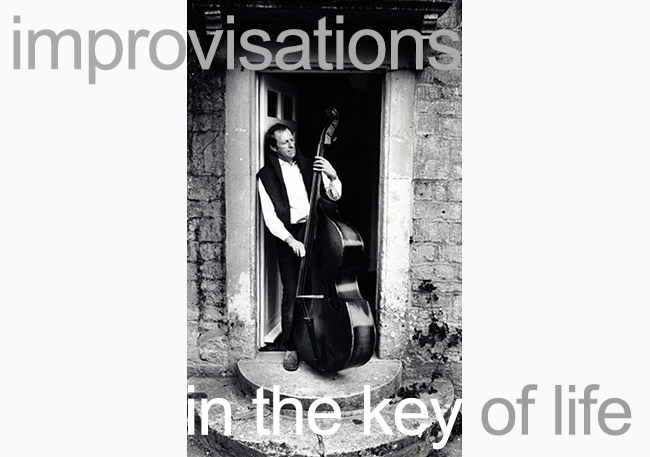
I met a man at a party in Bath in October who said he was looking for a bass player for a band he plays in.
‘I play the double bass,’ I said.
‘I know,’ he said. ‘That’s why I mentioned it. Our bass player’s gone missing. It’s a sort of traditional/mainstream jazz band which I started with friends in the navy a lifetime ago, and we get together still a few times in the year. The next is December 3rd in Putney, at my son’s engagement party. Are you game?’
I said I was game, because I don’t play nearly as much as I ought. When the time came, however, I was cussing and swearing and wishing I was staying in front of the fire when, of a damp, dark Friday afternoon, I drove the hundred miles from Bath to the Star and Garter, Lower Richmond Road. I’m glad I went, though, because I had almost forgotten the fun of playing in an old-style jazz band, in which you meet for the first time people who have nothing in common with you except the feeling that you wouldn’t all be in this ridiculous situation if you hadn’t collected the same records when young and wasted an equal amount of time learning a instrument to make the same sounds, so you must all be brothers…
Half a dozen complete strangers can play jazz together, thanks to the common repertoire, just as experience of the rules could also enable them to play bridge. This doesn’t prevent wrangling and horse trading between each tune, though. Someone says, ‘Let’s play “When Somebody thinks You’re wonderful" or, says ‘How about “Autumn Leaves”?’ And if more than 75% of the band know it, it usually gets the nod, at which point you have to discuss what key to play it in, which is more of a sticking point than you might imagine, especially if you only know the genteel world of string quartets. Agree to play a Mozart Quartet in A major, and you know you’re playing in A major. Agree to play Duke Ellington’s "Take the A Train” and you’ll get three people who want B flat, two who want C, one who thinks Duke recorded it in F and one person who waves around a chord book which says G major. That’s why groups have leaders. He’s the guy who says: 'I always play it in C so play it in C and shut up…’
An ideal bass player should be able to play any tune in any key. I am not an ideal bass player, but luckily I was standing beside an ideal guitarist called Tim who had a voluminous chord book which I could share in. Even so, there were some hairy moments in the evening. I played some tunes which I had only heard on record, and never played before, like “The World is Waiting For the Sunrise”, and by the time we got to the end of the tune I had worked out entirely what the chords were, but there was an exhilaratingly fearful moment in the middle when you are actually deducing AND memorising AND playing the harmony AND improvising all at the same time. At my time of life, I need to be creatively scared like that if I’m not to start dying too soon.
Most of the group, as I discovered from talking to them between whiles, had come to an even more interesting stage of life, namely that time when they were being bundled out of their careers at retirement age and looking for other things to do. For instance, Tim, the guitarist, had been something quite comfortable with British Gas until he had been offered a redundancy package which included £1,000 worth of retraining.
“I didn’t want to retrain as a gas fitter or plumber,” he said. “I wanted to leave the world of gas and play the guitar. On an impulse I asked if the offer covered guitar training, and they said they couldn’t see why not, so I took a thousand pounds worth of guitar lessons. Never regretted it.”
Malcolm the (very good) piano player had an even more inspiring story. He had pursued a life in the hotel trade and ended up in Kuwait doing some sort of hotel training scheme when Iraq invaded and the world erupted.
“I’ve still got two cars and a piano in Kuwait,” he said. “Don’t think I’ll see them again now. But I’ve moved on to becoming a brewer.”
This startled me, as my father, himself a brewer, always wanted me to follow him into the brewery in Wrexham, and I imagined Malcolm as a white-coated technician in some red brick barracks smelling of hops and steam. Not a bit of it. Malcolm runs a microbrewery in a village in Suffolk – Earl Soham – with four pubs attached, which sounds idyllic. Similarly, Terry the clarinet player had spent all his life flying planes for the Navy and was now doing an art and design course at his local college.
“Always wanted to see if I was any good at art and design,” he said. “Now I’m doing the course, I’ve discovered I don’t think I am, but I’m enjoying it a lot anyway.”
I never got to interview the other two members of the band in depth, but a pattern was emerging. People do something interesting for forty years, then when it starts to pall they do something even more interesting. The only member who didn’t conform to this pattern, was, well, me. Forty years ago my father asked me what I was going to do if I wasn’t going to be a brewer, and I said I wanted to be a humorous writer. He snorted sardonically and asked me what the pension scheme was like.
I ignored him, quite rightly, but now the question is beginning to make more sense. Of course, most of the time, like most writers, I feel I have hardly started, and probably will never stop writing, but all the same it makes a girl think about the future.
“Well,” said one of the band, “that was good fun. We might have another gig in the spring. You game?”
Sure am.
The Oldie
January 2000