


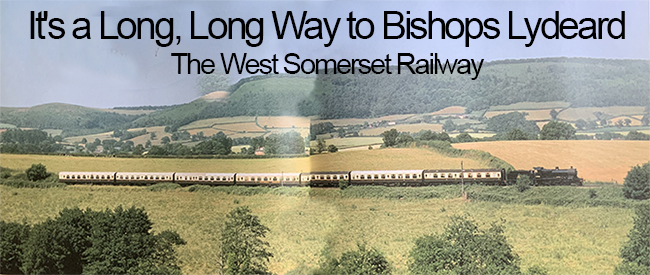
…The West Somerset Railway starts at Bishops Lydeard, a comfortable little sandstone town with nice church and old coaching inn next door in whose garden I sat with a coffee, deafened by the church bells. Finding the station was the hard bit. There isn’t a single sign to the WSR and I only came across it by accident, just across the main road outside the town and out of sight of the town. When I mentioned this lack of signs to the WSR people, they looked a bit shocked. Nobody ever came to the railway via the town, they said; they always came along the main road. It’s strange how some towns can be totally divorced from their stations and not make an effort at reconciliation, whereas at somewhere like Minehead, the other end of the line, they are in each other’s laps, willy-nilly.
Bishops Lydeard and Minehead seem worlds apart. The latter lives by and for the sea, whereas when you set out from Bishops Lydeard and plunge straight into a wood, you get no feeling of the sea being anywhere within a hundred miles. In fact you start climbing, which is an odd way to get to the seaside, and for the first four miles it’s uphill all the way, through woods and fields and, above all, hilly valleys, the kind of country which we have been trained to think of as typical GWR branch line country, for the very good reason that it was. On a sunny day it is hard to think of anything more beautiful, with the high line of the Quantocks occasionally visible over to the right, the buxom rise and fall of the Devonian landscape all around and over there on the left – according to the official guide – “the small village of Combe Florey, home of the author Auberon Waugh, whose large house can be clearly seen on the left hand side between the two bridges.”
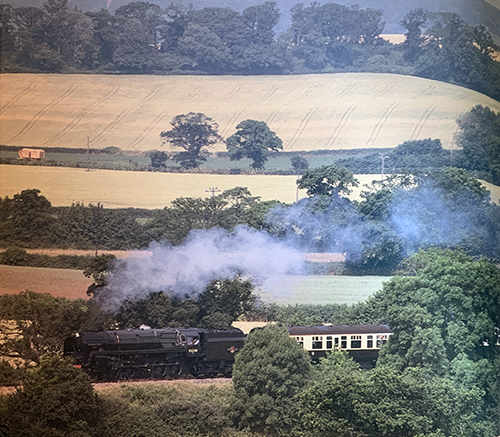
In other words, it can be briefly glimpsed. Everything is glimpses around here; the countryside is so tight, so neatly packed, that every time you think you are going to get a view, it’s taken from you by another little ridge, rill or outcrop rushing past, another twist as the railway attempts to come to terms with the contours. Never do you get a broad outlook to help you fix yourself in the map of England, and even if you did I suspect it would not be much help, as large settlements are strangely elusive around here. When you stop at Crowcombe you can’t see Crowcombe and the same goes for Stogumber (great GWR branch line names, by the way).
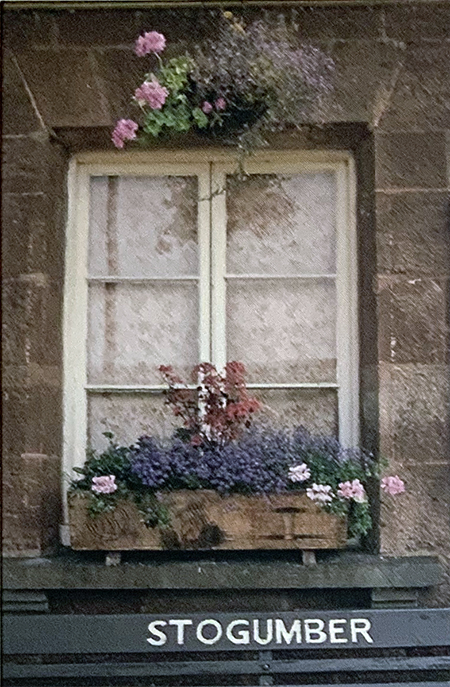
… After Crowcombe the train eases down to Stogumber, where the station building is on one side of the line, and the platform on the other, which is a bit like having the tower separate from the church, but when you have to build a station on the hillside, as you do at Stogumber, that is apparently the easiest way o construct it. After Stogumber there isn’t another stop for miles, just more lovely countryside and the sound of the engine bouncing back off the slopes, until we are down on the flat at last and imagining we are about to see the sea. We are not. We have to stop at Williton first. 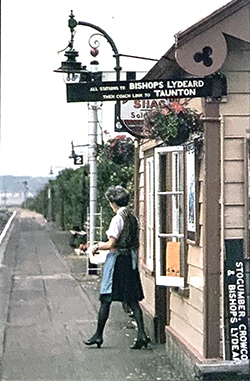 Big place, Williton. Well, anywhere looks big when you haven’t see anything much bigger than Auberon Waugh’s house for hours, but Williton seems big because it has the accoutrements of a railway depot, what with water towers, diesel sheds and so on. I am told in confidence that the centre of gravity is gradually passing from Minehead to Williton, and I believe it. Even now it is the sort of station which every line should have, the station somewhere in the middle where the passenger can get off and stroll down to the engine and stare intelligently at it, before strolling back to your seat; nobody on a steam train seems to go faster than a stroll, even if you are in danger of missing it.
The next station is called Doniford Beach Halt, so they can’t keep the sea from us much longer, and sure enough there it is, all zillion gallons of it, before we arrive at Watchet, the big port on the line. People outside Somerset tend not to have heard of Watchet, but as harbours in North Somerset go, it’s big news, and in some ways it is the main reason why the line was built at all. The railway used to end here, and from all accounts the effort in unloading the ships had a touch of high class farce about it. To keep harbour fees low and to catch the tide, staff were drafted in from as far as Taunton to unload the ships at lightning speed onto the waiting trucks as shunting had to be stopped for the passenger trains…
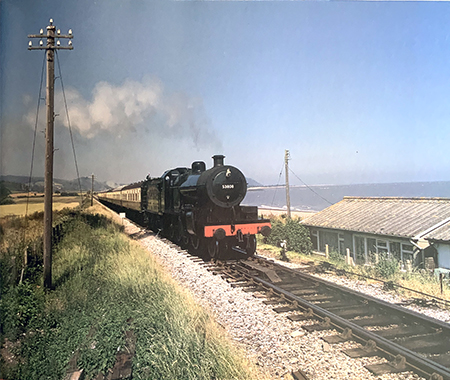
From here the line heads unexpectedly away from the sea, up a steep climb to Washford and back down to the sea line again at Blue Anchor, and from here it is a virtually straight run along the coast to Minehead, though you could stop off at Dunster if you wanted to. The Luttrells did. They lived at Dunster Castle for hundreds of years and were the prime movers in getting the line built to Minehead. Dunster is an incredibly beautiful historic town, crammed full every day during the season with National Trust-type crowds, while Minehead is much more workaday – a seaside town all right, but geared primarily to the holiday camp and boarding house crowd. On the flat it is all clotted cream teas, and beach windmills, and occasional arcade games, but up the hill at Minehead you also find the old town, quietly holding its breath…
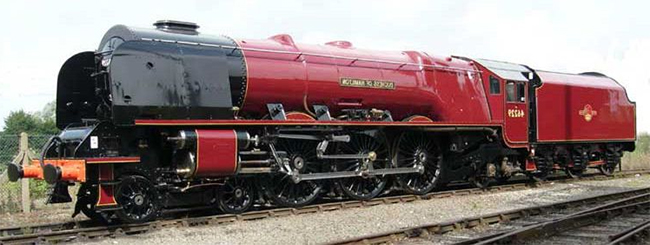
One of the oddest visitors to Minehead was the Duchess of Hamilton, which some would say was the finest steam train running in Britain today. But it was only rescued by the whim of Billy Butlin, the holiday camp king, who bought it in the 1960s and stuck it in the middle of Minehead camp for the children to play on, with no thought of it ever running again. It was finally purchased and taken away for restoration, like a Van Gogh that someone has been using as a dartboard, and now lives a pampered life in York…
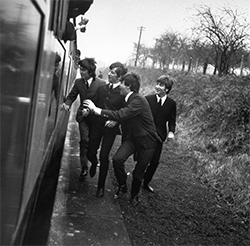
It all seems a long way from Bishops Lydeard. It really is quite a journey from one end to the other, helped a lot by the terrain; twenty miles in Somerset is a lot further than twenty miles across, say a fen or flatland and a lot more varied. I suppose that’s why so many film companies have chosen to film here, perhaps most famously of all, the railway sequences in the Beatles’ film A Hard Day’s Night, though it comes as a slight shock to realise that that must have been well before steam was restored, during British Rail’s last days of tenure. We sometimes think that of BR as having always been in charge, but come to think of it, in another ten years time the West Somerset Railway will have been in charge longer than BR ever was…
Photography Alain Le Garsmeur

| Book Extracts | |
 |
|
| Book Extracts | |