



There are two signs on the road out of Sweden into Norway on the Western Scandinavian Highway.
The first says: " You are now entering Norway".
The second says: " Welcome to Free Europe!"
Yes, the people of Norway feel that when you enter Norway you leave behind the bureaucratic totalitarian dictatorship of the EU and enter a place untrammelled by regulations, unworried by far-off masters.
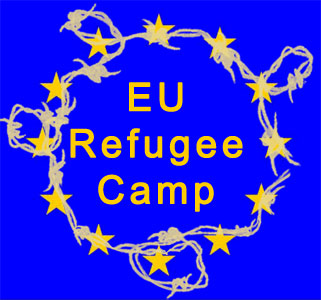
However, there is a third sign following the other two. It says: " Refugee Camp 2 km ahead ".
A refugee camp? There is a refugee camp in free Norway? In the last bastion of unregulated Europe, there are refugees and fugitives?
Yes, indeed. For here, just two miles across the border from the EU, there is a camp for refugees from the EU. Here, inside the only country in Europe which ever dared to say no to the EU and yes to itself, is a haven for people who couldn't or wouldn't live inside the EU.
' Welcome, welcome! ' says the commandant, Per Nordahl, as I enter the main gate of Lamontdal Freedom Camp. 'Welcome to free Europe! Fifty years ago the Nazis came here from Germany to occupy us! Today the tables are turned over and we are opening our gates to young Germans and Italians fleeing here as victims of the oppressive regime of the EU, or whatever it is calling itself this week, and you are welcome too!'
They are a motley crew here at Lamontdal. There are English Tory MPs who couldn't stand the strain any more. There are Sicilian gangsters who got caught in one scam too many, draining agricultural funds from Brussels. There are farmers from Britain, some of whom were driven mad by the compulsion to set aside, others who were driven wild by their inability to understand the regulations concerning set aside. There are interpreters from Strasbourg, home of the European Parliament, driven round the bend by each new language coming into the community. Men like Enzo Pafallo.
‘The last straw came when I had to learn Greek,’ says Pafallo, a man who already spoke five languages. ‘Suddenly my brain said - Enough! Bastante! Pouf! Pshaw! Merde! You already have five languages and you can think your own thoughts in none of them, only the thoughts of others. You are becoming a conduit for bureaucratic drivel! Intellectually, you are a main drain sewer! So I upped sticks and came to free Norway. The ironic thing is that I am now having to learn Norwegian, the very language which, after all, I would have been spared learning if I had stayed in Strasbourg!’
Although the administrative infrastructure of the camp is Norwegian, the inmates tend to make the rules themselves, as befits a truly international body united by one common bond: distrust of the men at Brussels.
‘We call the enemy Brussels, not the EU,’ says Per Nordahl, ‘because Brussels does not change its name. Psychologically, it is a very Third World symbol of insecurity and power-thirst, this urge to change names, like Burma becoming Myanmar and the Gold Coast becoming Ghana, and so on. People who are not sure of their identity change their names. Nobody has changed names faster than Europe. The Common Market, the EEC, the EC, the European Union - what next? Europe P.L.C.? The EU is like a product that is always being renamed and relaunched, which only happens when things are going badly.’
Many of the occupants of the camp have been here for some time, as they tend to settle into the life more comfortably than the authorities would wish. Visitors come and go - there was a film crew from Newsnight when I was there, and someone from the Guardian sending faxes home on, for some odd reason, House of Commons paper - but mostly there is little turnover. Per Nordahl wishes that things were not so comfy here.
‘In the wartime camps people were always escaping from the Germans. Here, nobody ever escapes. Occasionally we have people trying to break in. The other day we arrested someone trying to infiltrate into the camp who claimed to be a refugee from EU regulations on meat slaughtering and butcher's shops, but it turned out he was just another spy from Brussels.’
The occupants of the camp reflect the national mix of the EU itself, and Per Nordahl says that already the Germans and the French have combined to form a power bloc in this anti-EU camp.
‘Yes, interesting, isn't it? All the big committees in the camp are dominated by the Franco-German axis. I think the British here could play a much bigger part, but they always disagree with everyone and exercise their veto, so nobody wants to combine with them. I am afraid in some ways this camp is just replicating the mistakes of the EU. However, if they don't like it here, they can always go down the road to Portillostadt.’
‘Portillostadt?’
‘Yes. That is the camp for refugees from here at Lamontdal.’
(Tomorrow: I enter the forbidden world of Portillostadt.)
The Independent Friday Dec 2 1994
