


My father rather resented having to buy things which he could perfectly well have made himself. He also resented throwing away things which he felt could be useful. He combined both resentments once very neatly by building a wastepaper basket out of things which people had thrown away.
‘There you are,’ he said. ‘Every bit of that wastepaper basket has previously been thrown away and has now been resurrected. Refuse receiving refuse. Very poetic.
He inaugurated the wastepaper basket with a bottle of champagne. Not a full bottle of champagne. That would have been a waste. An empty one which had been lying round the kitchen for years in case anyone needed it as a candle holder, though nobody ever had.
‘I declare this wastepaper basket well and truly open,’ he said, throwing the champagne bottle into it. The impact shattered his handiwork and it fell to bits. Chagrined, he threw the bits of the wastepaper basket into the kitchen bin, but kept the empty champagne bottle.
‘You never know when you might need a candle holder,’ he said. ‘Or indeed an empty champagne bottle.’
‘Why would you ever need an empty champagne bottle, Dad?’ I asked.
He opened his mouth immediately. But not in time to stop me adding, 'Apart, of course, from the obvious eventuality of you starting your own champagne factory.’
He closed his mouth again, so I knew then that that is what he too had been going to say. He then opened it again and said, ‘You might wish to send a letter in a bottle. Champagne bottles would be ideal for that. The average bottle kicking around in the surf you wouldn’t look twice at – just think of all the times you’ve seen a bottle rolling around in the waves and all you thought was, “Oh what dreadful litter" – but a champagne bottle you would always look twice at just in case it was full. Then you’d spot the message.’
And there the matter might have rested if my mother hadn’t looked up from her sewing – she was doing souvenir Turin Shrouds for the local Catholic church at the time – and said, ‘Champagne bottles are made of dark glass.’
‘So what?’ said my father,
‘Well, you wouldn’t see the message through the glass of a champagne bottle, Think of all those times you’ve wondered if there was any champagne left in the bottle and you’ve held it up to the light and even then you can’t really see if there’s any champagne left. I think a champagne bottle would be the worst possible container for a message, even if you could get the cork back in.’
There was a pause here. A respectful pause while we all waited to see how my father would come back to this devastating critique.
‘That’s true’ he said. ‘Unless the message was written on… on…’
‘On what?’
‘I’m not sure,’ said my father.
And there we left it, mentally chalking it up to Mother as a win on points, until my father burst in about a week later holding a roll of oddly shiny-looking paper.
‘Know what this is?’ he asked.
‘Of course we do!’ cried my mother. 'It’s your will! Oh do, do, do read it to us!’
(She didn’t really talk like that, but she had recently been reading some Georgette Heyer and said she had been influenced. ‘What is the use of reading a book if you are not influenced by it?’ she once said to me. I think it is rather rude if you are not to be influenced by what you read.’)
‘It is some paper I have designed for writing messages on to put in champagne bottles.’ he said. ‘It is phosphorescent, and therefore of the message will be seen glimmering in a ghostly fashion through the glaucous glass,’
He put some paper into the empty champagne bottle and he was absolutely right. You could see the writing through the glass.
‘And how are you going to get the cork back in the bottle?’ my mother said. ‘Nobody can ever get a cork back into a champagne bottle.’
My father went very quiet and retired to his workshop where presently we heard the noise of breaking glass, but he must have failed in his attempt to produce a gadget, as he never mentioned it again.
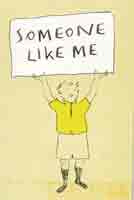
Someone Like Me
Published 2005

top
| Book Extracts | |
 |
|
| Book Extracts | |